


UK Sponsor Licence Guide (2026): Process, Costs and Key Requirements for Employers

Updated: Apr 18
A sponsor licence allows UK businesses to recruit workers from overseas under the Skilled Worker visa and other sponsored immigration routes.
As the UK labour market continues to experience shortages in certain sectors, more companies are exploring sponsorship as a way to access international talent. However, the process involves strict compliance requirements and several costs that employers must understand before applying.
In this guide, we explain the step-by-step process of obtaining a sponsor licence, the associated costs, and the key compliance obligations for UK employers.
What is a UK Sponsor Licence?
A sponsor licence is permission granted to a UK organisation by the Home Office allowing the sponsoring of migrant workers to work in the UK. This applies to migrants already in the UK on another visa type and those seeking to enter the UK for the first time.
Once approved, the employer can issue a Certificate of Sponsorship (CoS) to a worker, which allows that individual to apply for a work visa.
Most employers apply for a sponsor licence to sponsor workers under the ‘Worker’ licence. However, the ‘Temporary Worker’ licence may be suitable for those on any of the 5 Global Business Mobility routes below:
Senior or Specialist Worker
Graduate Trainee
UK Expansion Worker
Service Supplier
Secondment Worker
Who Can Apply for a Sponsor Licence?
To qualify for a ‘Worker’ sponsor licence, an organisation must:
Be a genuine and operating UK business
Have appropriate HR systems to manage sponsored workers
Demonstrate that it can comply with sponsorship duties
Appoint key personnel to manage the licence
The Home Office will assess whether the business is credible and capable of fulfilling its compliance duties.
Step-by-Step Process to Obtain a Sponsor Licence
1. Assess eligibility and prepare documents
Before applying, the business must ensure that it meets the eligibility criteria and gather supporting documents.
Standard documentation required includes:
Certificate of incorporation
Business bank statements
VAT registration certificate
PAYE registration certificate
Employer’s liability insurance
Evidence of business premises
The Home Office requires at least four supporting documents depending on the business type.
2. Appoint Key Personnel
The organisation must nominate the following roles:
Authorising Officer
Senior person responsible for immigration compliance.
Key Contact
Main point of contact with the Home Office.
Level 1 User
Person responsible for managing the sponsor licence through the Sponsor Management System (SMS).
These individuals must usually be based in the UK and have no relevant criminal convictions or immigration breaches.
For more details see our blog.
3. Submit the Sponsor Licence Application
The application is submitted online through the Sponsor Management System (SMS).
After completing the online form, the employer must:
Pay the relevant Home Office fee
Submit supporting documents within 5 working days
4. Home Office assessment
The UK Home Office will review the application and may:
Request additional documents
Request an online pre-compliance interview
Conduct a pre-compliance visit to the business premises
These visits are designed to assess whether the company has appropriate HR systems in place.
5. Decision
The standard processing time is around 8 weeks. A priority service may reduce this to around 10 working days, but this is not a guarantee.
If successful, the business will receive an A-rated sponsor licence, allowing it to assign Certificates of Sponsorship. The licence is granted indefinitely.
Sponsors Can Only Sponsor Workers Within Their Genuine Area of Trading
One of the key requirements under the sponsor licence system is that a business can only sponsor workers for roles that fall within its genuine area of trading and business activity.
The Home Office expects sponsors to demonstrate that the role being sponsored is genuine, necessary for the business, and consistent with the nature of the organisation’s operations.
In practice, this means that the job role must clearly relate to what the company actually does.
For example:
A software development company sponsoring a software developer would normally be considered consistent with its business activities.
A restaurant sponsoring a chef would fall within its normal trading activities.
A small retail business attempting to sponsor a nuclear engineer or research scientist would likely raise serious concerns for the Home Office.
During the sponsor licence application process, the Home Office may examine:
The company’s website and marketing materials
Companies House records
Business bank statements and invoices
The nature of the vacancy and job description
If the role appears unrelated to the organisation’s commercial activities, the Home Office may conclude that the vacancy is not genuine.
In such cases, the sponsor licence application may be refused or the Home Office may request further evidence or invite the organisation for a compliance interview to explain why the role is required.
Even after a sponsor licence is granted, sponsors must continue to ensure that any sponsored roles remain consistent with the organisation’s business operations. Attempting to sponsor workers for roles outside the company’s area of trading could result in compliance action, including suspension or revocation of the licence.
For this reason, it is important that employers carefully consider which roles they intend to sponsor and ensure that these roles can be clearly justified as part of the company’s legitimate business activities.
Sponsor Licence Costs (2026)
There are several government fees associated with sponsoring workers.
Sponsor licence application fee
The cost depends on the size of the organisation.
Small companies or charities:
£574
Medium or large companies:
£1,579
A business is usually considered small if it meets at least two of the following:
Annual turnover under £10.2 million
Assets under £5.1 million
Fewer than 50 employees
Optional priority processing
The Home Office offers a priority service for sponsor licence applications.
Cost:
£500
This may reduce the processing time to around 10 working days (subject to availability).
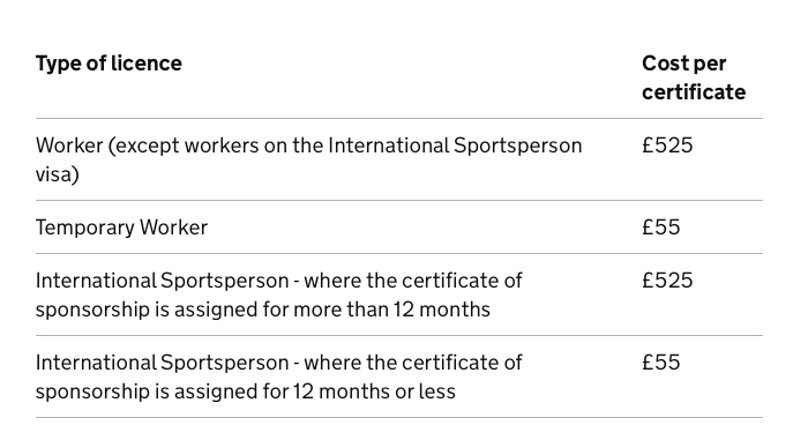
Certificate of Sponsorship (CoS)
Each sponsored worker requires a Certificate of Sponsorship.
Immigration Skills Charge (ISC)
Employers sponsoring workers under the Skilled Worker route must also pay the Immigration Skills Charge.
Small or charitable sponsors:
£480 per year of sponsorship
Medium or large sponsors:
£1,320 per year of sponsorship
Example:
Sponsoring a worker for 5 years would cost:
Small sponsor£2,400 in ISC + £525 in Certificate Issuance
Large sponsor£6,600 in ISC + £525 in Certificate Issuance
Is Sponsorship Right for Your Business?
A sponsor licence can provide access to a global talent pool, helping businesses fill critical skills shortages.
However, employers should ensure they:
Understand the compliance obligations
Have appropriate HR systems
Budget for the associated costs
How Lace Law Can Help with Your UK Sponsor Licence Guide
At Lace Law LLP, we assist businesses throughout the sponsor licence process, including:
Preparing and submitting sponsor licence applications
Advising on appropriate SOC codes and salary thresholds
Conducting mock compliance audits
Supporting businesses during Home Office compliance visits
Assisting with Skilled Worker visa applications
Contact us today to find out more.


