Earned Settlement UK Reforms: Home Affairs Committee Warns of Risks and Uncertainty

Updated: Apr 18
The Home Affairs Committee has published a significant report examining the Government’s proposed ‘Earned Settlement’ reforms, which could reshape how migrants qualify for indefinite leave to remain (ILR) in the UK. The report was published on 13 March 2026 and you can access it via this link.
While the Committee acknowledged the Government’s intention to manage migration levels, it warned that many elements of the proposals remain unclear, under-developed and potentially disruptive.
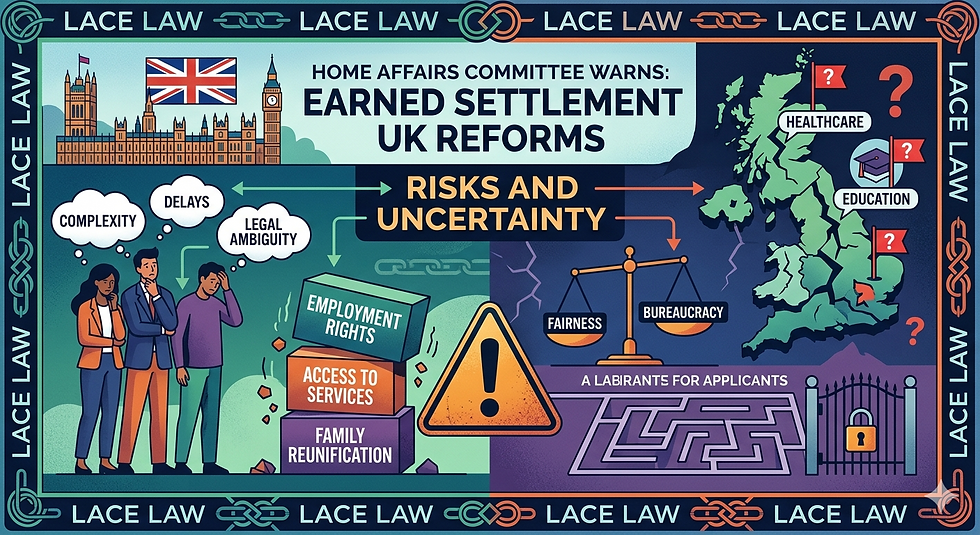
Uncertainty Around Implementation
A central concern highlighted in the report is the lack of a clear implementation timeline.
The Home Office has indicated that changes may begin from April 2026, but has not explained how or when specific reforms will be introduced. MPs warned that the scale of the proposed changes will require substantial adjustments to Home Office systems and staffing.
The Committee noted that suggesting implementation could begin in April 2026 has already caused significant distress among migrants who are approaching eligibility for settlement under the current rules.
Transitional Protections and Retrospective Application
The Committee also raised concerns about the possibility that the reforms could be applied retrospectively to migrants already living in the UK.
MPs recommended that the Government introduce clear transitional arrangements, particularly to protect individuals who have structured their immigration plans around the existing settlement framework.
The report suggests that the new rules should not be applied to migrants who arrived before 2021 and who are progressing towards settlement through current long-residence routes.
Financial Requirements and Faster Settlement for High Earners
Proposals to introduce minimum income thresholds for settlement eligibility were also scrutinised.
Although the Committee accepted that economic contribution is a legitimate consideration in settlement policy, it emphasised that reasonable exemptions must be provided for individuals who cannot work due to disability, caring responsibilities or full-time study.
MPs were particularly critical of proposals to allow faster settlement for higher earners, noting that the Home Office has not clearly justified how the proposed thresholds have been determined. The report suggests these thresholds appear to be based on income tax bands, which may represent a simplistic proxy for integration or economic contribution.
Concerns About Occupation-Based Settlement Routes
The Committee also questioned the logic of linking settlement timelines to occupational classifications or skill levels.
This approach could lead to inconsistent outcomes, where some higher-earning workers face longer routes to settlement than lower-earning individuals in different sectors. MPs described the use of occupational categories as a proxy for income as both “odd and unnecessary”.
Impact on Families, Children and Poverty Risks
The report highlights the potential impact of longer settlement routes on children growing up in the UK.
Under certain scenarios, children could spend most of their childhood holding temporary immigration status or reach adulthood before their parents become eligible for settlement.
The Committee recommended that young people who grow up in the UK should be granted settled status by the age of 18, rather than being required to meet earned settlement criteria.
MPs also warned that extending settlement timelines for lower-income households could increase the risk of child poverty, particularly among families employed in sectors such as adult social care.
Challenges for the Adult Social Care Sector
The adult social care sector features prominently in the Committee’s analysis.
Following the expansion of the care worker visa route in 2022, the Government now faces a difficult policy choice. Allowing large numbers of care workers to reach settlement may increase migration figures, while extending settlement routes could heighten financial hardship, increase exploitation risks and encourage workers to leave the sector.
The Committee noted a lack of clear evidence that the immigration reforms are being coordinated with the Government’s broader strategy for workforce planning in social care.
Earned Settlement UK Reforms - Risk of Increased Exploitation
Finally, the report warns that significantly longer settlement routes, particularly where migrants remain dependent on sponsorship, could intensify power imbalances between employers and migrant workers.
In some scenarios, migrants may remain on temporary status for up to 15 years, which could increase vulnerability to exploitation unless more flexible immigration arrangements are introduced.
Key Takeaway
The Home Affairs Committee has urged the Government to adopt a measured and transparent approach to earned settlement reforms.
Without clear timelines, transitional protections and carefully designed eligibility criteria, the proposed changes risk creating uncertainty for migrants, unintended labour market consequences and wider social impacts.
For individuals currently planning their pathway to settlement, it will be essential to monitor developments closely and seek legal advice where appropriate.